
T:400-6130-885
E: cservice@xx.com
E: cservice@xx.com
5thfloor, Financial Innovation Plaza, 8-2 Pusi Road, Jiangbei New District, Nanjing
Friendly link (QQ: 3004257586)
Friendly link (QQ: 3004257586)
Views: 0 Author: Site Editor Publish Time: 2026-07-07 Origin: Site
Laundry day grinds to a halt when a crucial appliance component suddenly snaps in your hand. A broken mechanism disrupts your household routine immediately. However, replacing it serves as a fast, high-ROI DIY repair if you source the correct part. Many homeowners delay this fix due to a specific fear. They worry about ordering an incompatible part or breaking the fragile replacement piece during installation. These concerns often lead to expensive, unnecessary service calls.
This guide provides a strict evaluation framework for identifying the correct replacement door handle. You will learn how to compare material durability, navigate sourcing options, and execute a risk-free installation. We help you restore your appliance quickly and confidently. You can skip the repair technician and handle this simple project yourself.
Finding the exact replacement requires more than a simple visual comparison. Manufacturers update their designs constantly. An appliance built in 2018 may use entirely different mounting hardware than a 2019 model. Therefore, you must rely entirely on specific appliance identification tags.
You cannot guess your appliance model number. You must find the official factory sticker. This small label contains the exact sequence needed to cross-reference parts catalogs. Finding it usually takes only a few seconds.
Once you locate the sticker, write down the full sequence. Do not omit any dashes or trailing letters. You will plug this exact sequence into a manufacturer parts catalog. This search yields an exploded diagram of your machine. It shows the exact part number for your required replacement.
Many online marketplaces group replacement parts by visual appearance. This approach traps unsuspecting buyers. Two parts might look identical on your screen. However, they often feature slight millimeter variations in their mounting pegs. A peg shifted by two millimeters will not fit your appliance door. You cannot force it into place without breaking it.
We define center-to-center hole measurements as a non-negotiable standard. If your original unit used screws, measure the exact distance between the screw holes. Clip alignments also matter. Count the exact number of retention clips on your broken piece. Compare this layout against the replacement door handle. If the clip spacing differs, the part will not fit.
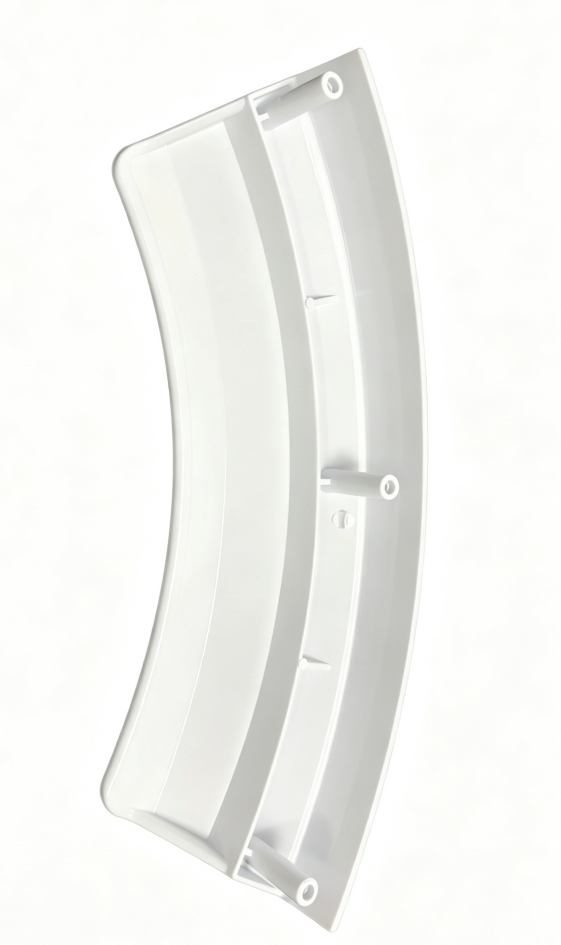
Understanding appliance materials helps you make a better purchase decision. You need to know why the first part failed. This knowledge prevents you from making the same mistake twice. It also guides your choice between factory parts and third-party alternatives.
Most factory handles consist of molded ABS or polycarbonate plastic. These materials offer decent strength at low manufacturing costs. However, they face a hostile operating environment. Your appliance generates intense heat during a cycle. It then cools down rapidly when finished. This continuous heat cycling causes the plastic to expand and contract constantly.
You add physical pulling force to this stressed material. Every time you open the door, you bend the plastic slightly. Over time, micro-fractures develop deep inside the polymer chain. These tiny cracks grow larger with every pull. Eventually, the weakened plastic shears completely. The failure feels sudden, but it actually develops over several years.
OEM parts come directly from the appliance brand. They offer a guaranteed baseline of performance.
Pros: You experience zero friction during installation. The dimensions match perfectly. The color aligns exactly with your machine. Using OEM parts ensures compliance with any remaining original warranty specs.
Cons: Brands charge a premium price for these pieces. More importantly, OEM parts use the exact same plastic mold. The new piece remains susceptible to the exact same wear pattern. It will likely break again in a few years.
Third-party manufacturers produce competing replacement parts. These options require more careful evaluation.
Pros: Aftermarket parts deliver excellent cost-efficiency. They usually cost a fraction of the OEM price. Interestingly, some third-party vendors actively improve the design. They re-engineer the mold to reinforce known stress points. They might add internal ribbing to strengthen the plastic.
Cons: Variable quality control plagues the aftermarket industry. You risk buying poorly molded plastic. You also face a risk of slight color mismatch. An aftermarket "appliance white" might look slightly yellowish next to an OEM "cool white" panel.
| Evaluation Criteria | OEM Parts | Aftermarket Solutions |
|---|---|---|
| Fit Guarantee | 100% exact match | Variable based on vendor |
| Material Durability | Identical to original | Sometimes reinforced, sometimes weaker |
| Color Matching | Perfect factory match | Potential slight variations |
| Price Point | Premium markup | Highly cost-efficient |
Your installation experience depends entirely on the mounting architecture. Manufacturers use two primary design languages. You must identify which configuration your appliance uses before ordering a replacement.
Snap-on (Friction Fit): This design relies entirely on interlocking plastic tabs. You push the piece into slots on the metal panel. The tabs flex and then snap firmly into place. This looks clean from the outside. However, it requires precise alignment. If you push at the wrong angle, you will snap the tabs instantly. A broken tab ruins the new part before you even use it.
Screw-mounted: This configuration uses physical fasteners. Manufacturers typically use Phillips or Torx screws. Sometimes they hide these screws behind a small cosmetic plate. Sometimes they expose them on the inner door panel. Screw-mounted designs offer much higher structural integrity. They handle pulling force better than friction-fit models.
Before you click the buy button, review the hardware situation. Many buyers assume a new door handle includes everything needed. This assumption often leads to frustration.
Proper installation separates a lasting repair from a frustrating failure. You must approach the task with patience. Rushing the process usually damages the appliance finish or breaks the new plastic.
Safety comes first. Always disconnect appliance power before starting. Modern machines often run capacitive touch wiring near the door frame. You do not want to short out a control board accidentally.
Next, you must remove the broken plastic shards. Do not use a metal flathead screwdriver for this task. Metal tools scratch appliance enamel instantly. Scratched enamel leads to unsightly rust spots. Instead, use a non-marring pry tool. A plastic putty knife works perfectly. Slide it gently under the broken housing. Apply slow, even pressure until the remaining plastic pops free.
New plastic behaves differently depending on its environment. You must account for basic material physics.
Temperature Factor: Never install a cold plastic piece. For example, a delivery truck might drop off the package in the middle of winter. Cold plastic becomes extremely brittle. If you try to snap cold tabs into place, they will shatter. Let the part sit on your kitchen counter for two hours. Let it reach room temperature. Warm plastic regains its necessary flexibility.
Torque Control: If your unit uses screws, put your power tools away. Never use an impact driver or power drill. They apply too much torque too quickly. They will crack the new plastic housing instantly. Use a manual screwdriver. Hand-tighten the screws gently. Stop turning as soon as you feel firm resistance.
Do not load laundry immediately. You must validate the repair first. Close the door slowly. Listen for the distinct click of the latch mechanism. Pull it open again. It should feel smooth and secure.
Next, inspect the rubber door seal. The newly installed piece must not warp the inner door panel. Run your hand along the gap. Ensure the door seal remains perfectly flush against the metal chassis. A gap will let hot air escape during operation. This ruins drying efficiency and wastes energy.
You know the exact model number. You understand the materials. Now you must decide where to spend your money. Your choice depends on your personal urgency.
Consider how long you can survive without the appliance. If your laundry pile grows rapidly, time matters most. Local appliance supply stores offer same-day resolution. You can drive there and pick up the part immediately. However, local shops usually charge a significant retail markup.
If you can wait a few days, shop online. Online aggregators offer much lower prices. They stock massive inventories. The trade-off involves shipping downtime. You must balance the cost savings against the inconvenience of a broken machine.
| Sourcing Channel | Speed of Delivery | Price Expectation | Inventory Size |
|---|---|---|---|
| Local Supply Store | Same Day | High Markup | Limited |
| Manufacturer Direct | 3-5 Days | Premium MSRP | Comprehensive |
| Online Aggregators | 2-4 Days | Highly Discounted | Massive |
Vendors handle appliance parts uniquely. Many refuse returns on opened packages. They do this to prevent buyers from testing parts and returning them dirty. You must scrutinize the return policy before buying.
Prioritize vendors with straightforward, no-restocking-fee policies. Look for rules specifically allowing returns for "opened but uninstalled" parts. This protects you in case you ordered the wrong fit. You want a safety net if the tabs do not align correctly.
You have the knowledge needed to proceed. First, locate the appliance model number. Second, select a vendor offering clear compatibility lists. Finally, place your order. Keep your non-marring tools ready for delivery day.
Replacing this component serves as a straightforward part-swapping exercise. It does not require an engineering degree or expensive service calls. Success depends entirely on strict model-number adherence. You cannot rely on visual similarities when ordering.
We reiterate that patience during the installation phase guarantees success. Specifically, you must respect plastic tabs and control your screw torque. These represent the final barriers to a lasting repair. Let the plastic warm up, use hand tools, and validate the door seal. Follow these steps to restore your appliance quickly and safely.
A: No. Adhesives typically fail quickly in this environment. Even industrial epoxies struggle against the combined stress of intense heat cycling and repeated pulling force. The plastic expands and contracts, breaking the glue bond. Full replacement remains the only durable, long-term solution.
A: Manufacturers often release color variations under the same base model number. You might see white, bisque, chrome, or black options. Additionally, brands sometimes execute mid-year manufacturing revisions. Always check your specific serial number sequence if a parts catalog prompts you. This ensures you get the exact revision intended for your machine.
A: Truly "universal" appliance handles rarely exist. Each manufacturer uses proprietary latching geometries, clip spacing, and screw alignments. A generic piece will not properly engage the door switch. We strongly emphasize buying strict model-specific parts to ensure safe operation.
A: It depends entirely on the mounting style. Snap-on configurations require exterior work only. You simply pry out the old piece and snap in the new one. Conversely, internally screwed handles require you to separate the inner and outer door panels to access the hidden fasteners.


